
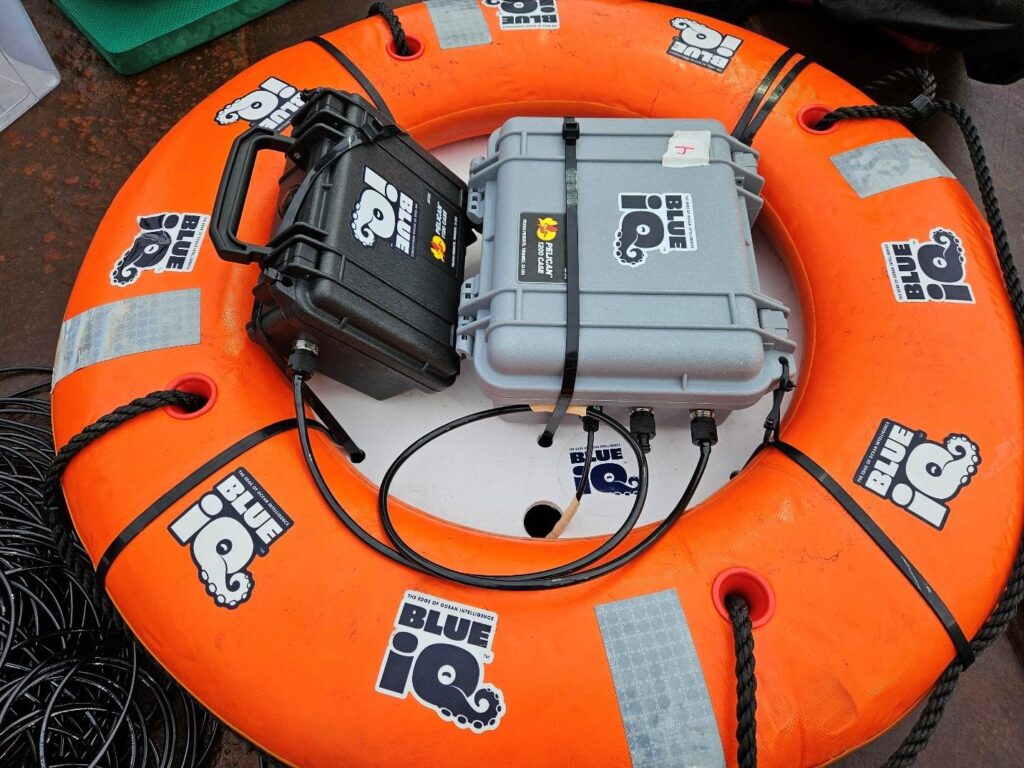
“Listening to the ocean” has a deeply poetic ring to it. And at NOAA, that poetry has become reality thanks to a public-private partnership that uses artificial intelligence (AI) and cutting-edge technology to turn deep-sea sounds into real-time, actionable intelligence.
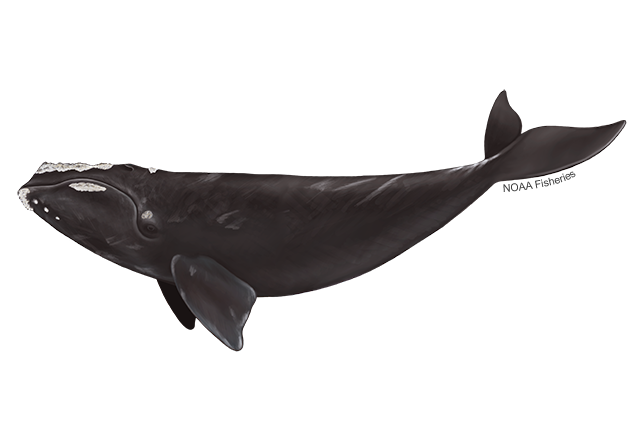
NOAA’s Northeast Fisheries Science Center, Passive Acoustics Branch has partnered with BLUEiQ for research and development on detecting and monitoring the North Atlantic Right Whale population. North Atlantic Right Whales (pictured below), are a critically endangered species and one of the rarest whales on the planet.
Historically, monitoring the sounds of the ocean in real time has required humans to be present, making it expensive, labor-intensive, and difficult to scale. However, BLUEiQ has created an ultra-low-power, autonomous, AI-driven sensor called OpenEar™ that can collect constant, real-time ocean sounds without a human presence. The sensors use AI to process the data locally, on the sensors themselves while at sea. This allows the sensors to deliver results without needing constant connectivity to the cloud.
The OpenEar™ sensors make it possible to monitor the North American Right Whale population in the deep ocean on a consistent and cost-effective basis. As the lead NOAA scientist working with BLUEiQ, Annamaria DeAngelis says, “Working with BLUEiQ has been a great partnership. They are very keen to get their system up and running for real-time monitoring of marine mammals. Providing BLUEiQ with the opportunity to gather on-the-spot data by testing their system in the deep water will be invaluable towards its development. Bioacoustics is a multidisciplinary field, which is exemplified in this project—bringing together biologists, computer scientists, and engineers to conserve whales.”
The partnership, which is under a Cooperative Research and Development Agreement, or CRADA, is already bearing fruit, as a recent deep-ocean deployment in Georges Bank off the U.S. East Coast allowed BLUEiQ to validate the technology in a deep-ocean environment.

NOAA’s mandate to conserve and manage marine resources, including endangered species like the North Atlantic Right Whale, is part of the mission that drives NOAA’s scientific excellence. The partnership with BLUEiQ adds the speed and innovation that characterizes startups to advance the capabilities for monitoring North American Right Whales in a way that wasn’t previously possible—consistently, in real time. Not only does the constant, real-time monitoring give scientists and NOAA staff a greater ability to monitor and measure the North American Right Whale population, it also allows scientists to monitor the ocean sounds for vessel strikes, a major threat to the critically endangered species.
DeAngelis and BLUEiQ CEO Kim Gavin are excited to see where the partnership will go next. At the end of the day, Gavin says, the collaboration with NOAA is “about turning sound into intelligence, and partnership into progress. By combining BLUEiQ’s entrepreneurial innovation with NOAA’s scientific excellence, we are accelerating the future of persistent, autonomous, and ubiquitous underwater sensing—a foundation for better science, stronger sustainability, and a smarter ocean.”
She adds, “It also underscores the growing importance of public–private partnerships in the Blue Economy—where agility from industry and scientific excellence from government combine to deliver real-world impact. For NOAA and BLUEiQ, it’s proof that when we listen more closely, we discover more than sound—we discover solutions.”
NOAA regularly partners with private sector companies through CRADAs to conduct research and development work that is mutually beneficial to accomplish NOAA’s mission. NOAA CRADAs are coordinated through NOAA Research’s Office of Research, Transition and Application Technology Partnerships Office.