Official websites use .gov
A .gov website belongs to an official government organization in the United States.

Secure .gov websites use HTTPS
A lock ( ) or https:// means you’ve safely connected to the .gov website. Share sensitive information only on official, secure websites.

Partnerships

A smartphone in the foreground shows a NOAA Weather Radio alert, which the background shows a radio tower against a sunset

NOAA and SpectraRep, LLC Collaborate to Evaluate Broadcast Datacasting for NOAA Weather Radio Resiliency

NOAA’s National Weather Service has entered into a Cooperative Research and Development Agreement (CRADA) with SpectraRep, LLC to evaluate broadcast television datacasting as a backup method for delivering NOAA Weather Radio alerts.

NOAA and SpectraRep, LLC Collaborate to Evaluate Broadcast Datacasting for NOAA Weather Radio Resiliency Read More »

A braided stream and streambed next to a forest

NOAA’s Office of Water Prediction signs agreement with Upstream Tech, Inc. to evaluate state-of-the-art AI in water prediction forecasts

National Weather Service’s Office of Water Prediction has signed a Cooperative Research and Development Agreement with Upstream Tech, Inc., to evaluate how artificial intelligence (AI)-based forecasts can be used to support operational water prediction capabilities, which inform decision-making for water management, flood response, and emergency services.

NOAA’s Office of Water Prediction signs agreement with Upstream Tech, Inc. to evaluate state-of-the-art AI in water prediction forecasts Read More »

A line of people fishing off a wooden pier extending over blue water.

NOAA’s Southwest Fisheries Science Center partnership leverages AI to track and measure federally-managed fish

NOAA’s Southwest Fisheries Science Center recently signed a Cooperative Research and Development Agreement with Fishtechy, Inc.—a small business that helps anglers accurately measure the size of their catch—to develop the Fishtechy app for commercial and recreational anglers.

NOAA’s Southwest Fisheries Science Center partnership leverages AI to track and measure federally-managed fish Read More »

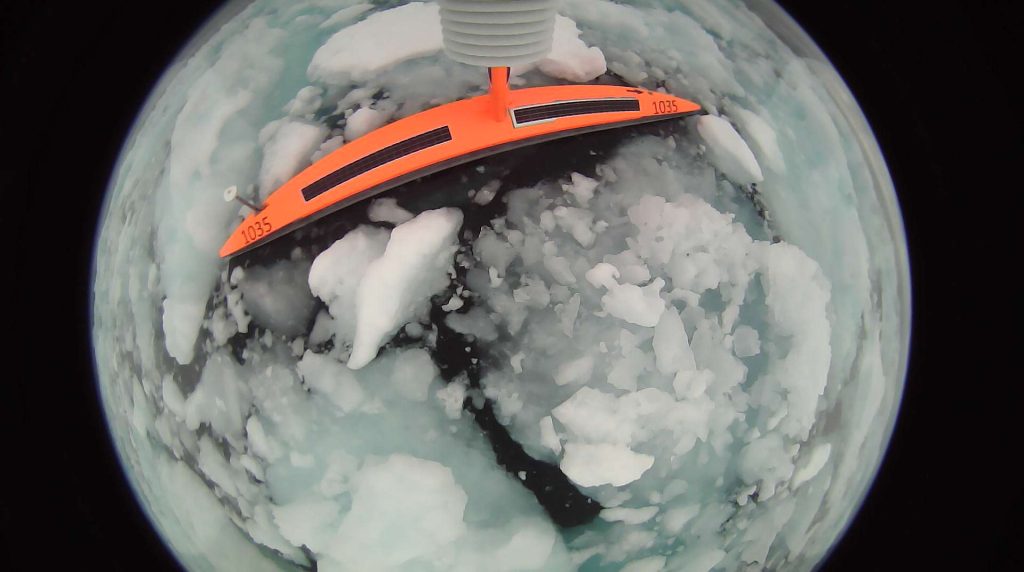
A saildrone surrounded by sea ice

Exploring the Pacific Arctic Seasonal Ice Zone With Saildrone USVs

NOAA PMEL researchers sent ocean drones to the U.S. Arctic to test their remote navigation capabilities close to ice and to collect data on Arctic weather, climate, and ecosystems. The saildrones were equipped to observe oceanic and atmospheric variables that are needed to estimate air-sea fluxes of heat, momentum, and carbon dioxide. Comparing Saildrone data to data obtained through existing collection methods allowed researchers to identify ways to improve ice navigation in the future.

Exploring the Pacific Arctic Seasonal Ice Zone With Saildrone USVs Read More »