Official websites use .gov
A .gov website belongs to an official government organization in the United States.

Secure .gov websites use HTTPS
A lock ( ) or https:// means you’ve safely connected to the .gov website. Share sensitive information only on official, secure websites.

Technology Marketplace

Parent category for available technologies to be featured on the website.

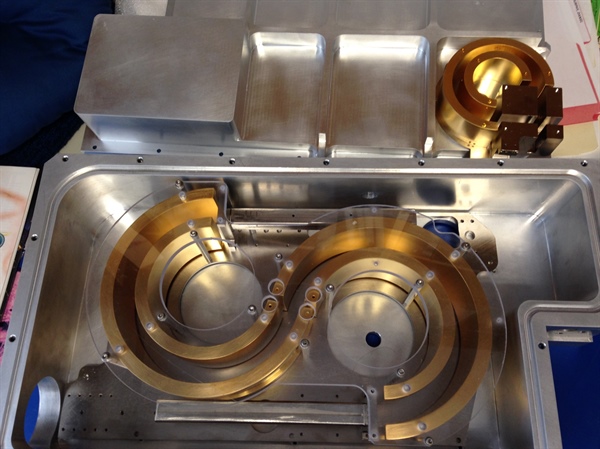
S Curved Time of Flight Chamber

S-Curve Time of Flight Mass Spectrometer

US Patents 9,761,431 and 10,438,788 – Exclusive and Non-Exclusive Patent Licenses Available Time-of‐flight mass spectrometers are commonly used in analytical chemistry and many other applications. They contain a region where ions travel toward a detector. NOAA scientists have developed a new geometry that has improved performance over existing designs. The new innovation is to use two successive sectors, with the second one reversed, in a geometry resembling an “s”. The result is that the output ion beam is parallel to the input ion beam and that the entire geometry folds into a very compact volume. A second benefit to the design is that certain higher-order aberrations cancel when the ion beam makes two identical but opposed turns (e.g. a right-hand turn followed by a left-hand turn). NOAA is seeking qualified licensees to manufacture and sell this patented device.  Interested companies should contact the NOAA TPO at noaa.t2@noaa.gov for more information.  Shaped Time of Flight Chamber. Machined prototype. Credit: NOAA

S-Curve Time of Flight Mass Spectrometer Read More »

Four Channel Cavity Ringdown NOy Detector

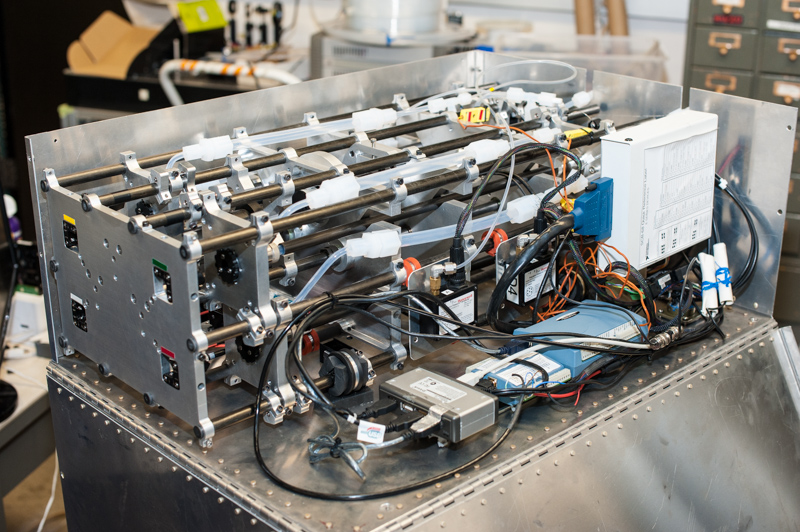
The instrument has lower power, size, weight, and vacuum requirements than a chemiluminescence-based instrument while approaching its sensitivity, precision and time response. In the NOy CRDS instrument of the present invention, NOy and its components are converted into NO2 by thermal decomposition (TD) in a fused silica inlet (henceforth referred to as quartz, following convention), followed by the addition of ozone to convert NO to NO2. NO2 is then measured using a cavity ring-down spectroscopy instrument, utilizing a 405 nm laser. The device may comprise four parallel channels, each driven by the same laser, to measure NO, NO2, NOy and O3, respectively, such that overall NOy may be measured, as well as its components NO, NO2, as well as ozone (O3).

Four Channel Cavity Ringdown NOy Detector Read More »

sub-surface automated dual water sampler (SAS)

Sub-Surface Automated Dual Water Sampler (SAS)

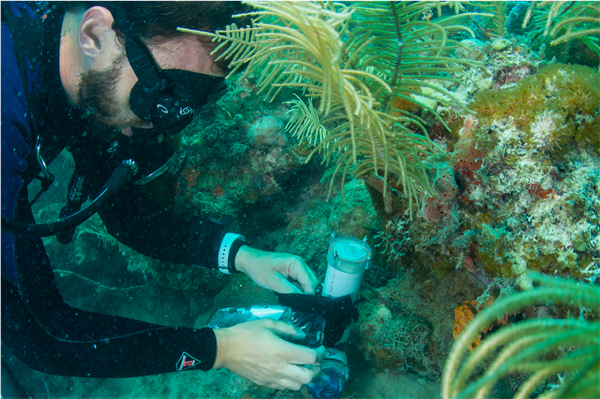
Sub-Surface Automated Dual Water Sampler (SAS)Designed by researchers at NOAA’s Atlantic Oceanographic and Meteorological Laboratory (AOML) and the University of Miami to help scientists study water chemistry on shallow reef habitats. Explore the SAS website, use it to guide you in building and using your own water samplers, embrace the maker movement, and improve on our design. If you are a teacher, there are free lesson plans to download that include labs and activities related to science, technology, and engineering.  Check out the NOAA SAS website and please use the SAS to learn about and explore our oceans!

Sub-Surface Automated Dual Water Sampler (SAS) Read More »

Open Source Temperature Sensors for Coral Reefs

Opuhala Sea Temperature Sensor

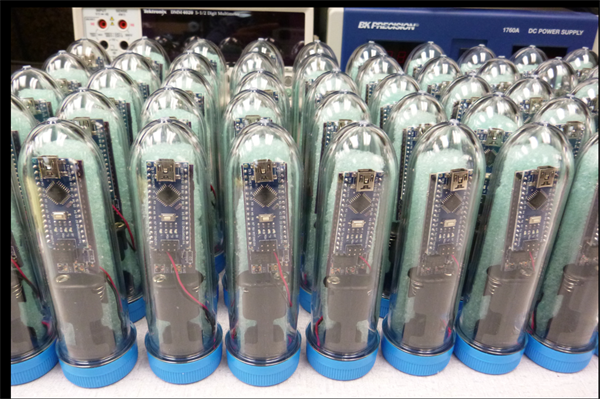
Opuhala was the ancient Hawaiian goddess of corals and spiny creatures. The National Oceanic and Atmospheric Administration (NOAA) Coral Health & Monitoring Program has chosen this name to represent the project to study the influence of fluctuating sea temperatures on the growth and health of corals around the world, and also to compare the in situ data with satellite-measured data in an effort to improve satellite algorithms. Three different types of coral reefs: fringing, barrier, and atolls will be monitored at 5m, 10m and 15m depths, where appropriate. The sea temperature sensor developed for the Opuhala project has been developed with low cost in mind because of the diversity of sites that will measure sea temperature in this global project.  Learn more about the Opuhala Project. Download Specifications and Software to make your own sensor.

Opuhala Sea Temperature Sensor Read More »

A UAV-based active AirCore system for measurements of greenhouse gases

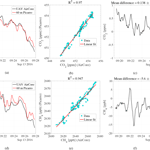
A UAV-based active AirCore system for measurements of greenhouse gases We developed and field-tested an unmanned aerial vehicle (UAV)-based active AirCore for atmospheric mole fraction measurements of CO2, CH4, and CO. The system applies an alternative way of using the AirCore technique invented by NOAA. As opposed to the conventional concept of passively sampling air using the atmospheric pressure gradient during descent, the active AirCore collects atmospheric air samples using a pump to pull the air through the tube during flight, which opens up the possibility to spatially sample atmospheric air. The active AirCore system used for this study weighs ∼ 1.1 kg. It consists of a ∼ 50 m long stainless-steel tube, a small stainless-steel tube filled with magnesium perchlorate, a KNF micropump, and a 45 µm orifice working together to form a critical flow of dried atmospheric air through the active AirCore. A cavity ring-down spectrometer (CRDS) was used to analyze the air samples on site not more than 7 min after landing for mole fraction measurements of CO2, CH4, and CO. We flew the active AirCore system on a UAV near the atmospheric measurement station at Lutjewad, located in the northwest of the city of Groningen in the Netherlands. Five consecutive flights took place over a 5 h period on the same morning, from sunrise until noon. We validated the measurements of CO2 and CH4 from the active AirCore against those from the Lutjewad station at 60 m. The results show a good agreement between the measurements from the active AirCore and the atmospheric station (N = 146; R2CO2: 0.97 and R2CH4: 0.94; and mean differences: ΔCO2: 0.18 ppm and ΔCH4: 5.13 ppb). The vertical and horizontal resolution (for CH4) at typical UAV speeds of 1.5 and 2.5 m s−1 were determined to be ±24.7 to 29.3 and ±41.2 to 48.9 m, respectively, depending on the storage time. The collapse of the nocturnal boundary layer and the buildup of the mixed layer were clearly observed with three consecutive vertical profile measurements in the early morning hours. Besides this, we furthermore detected a CH4 hotspot in the coastal wetlands from a horizontal flight north to the dike, which demonstrates the potential of this new active AirCore method to measure at locations where other techniques have no practical access. View/Download Article   Andersen, T., Scheeren, B., Peters, W., and Chen, H.: A UAV-based active AirCore system for measurements of greenhouse gases, Atmos. Meas. Tech., 11, 2683–2699, https://doi.org/10.5194/amt-11-2683-2018, 2018.

A UAV-based active AirCore system for measurements of greenhouse gases Read More »